personal development

I am a certified Pega Senior System Architect and a great believer in lifelong learning.
I continue to develop my knowledge and skills. Here some of the training I have attended and skills that I have acquired.
Generative AI for PowerPoint and Word to Optimize Content Cr
Training
This course explores using Microsoft Copilot to craft effective prompts to generate text, slides, and structured content in Word and PowerPoint, and to optimise workflow efficiency by automating routine tasks and enhancing document creation. It highlights techniques to refine AI-generated content, ensuring clarity, coherence, and logical flow in presentations and documents.

Data Analysis and Visualization with Generative AI in Excel
Training
This course explores using Microsoft Copilot with Excel to work with data more effectively. Topics include transforming raw data into meaningful insights and visualisations with Copilot's Generative AI features, including advanced techniques for manipulating data, generating insights, creating visualisations, and summarising information.
Even after using Microsoft Excel for so many years, this course taught me about a few features I didn’t know about.
Fundamentals of Microsoft 365 Generative AI
Training
This course provides an introduction to Microsoft 365 Copilot and includes modules on prompt engineering, information retrieval with Copilot, and content generation in Word. Possibly the most interesting parts of this course for me were information retrieval and content generation with Word, which I had dabbled with in the past but had never fully used.
The Role of the Technical Trainer in the Age of AI
The Role of the Technical Trainer in the Age of AI
I have been working as a Technical Trainer in the IT Industry since the late 1980s. For most of that time, I have seen this role as combining content delivery, technology expertise, and classroom management to build student skills and meet their expectations. But in the age of AI, as it becomes a standard practice across industries, this role will change.
Traditionally, in a Technical Training environment, using tools like MS PowerPoint to present content, combined with demonstrations to show how the technology works. Follow-up hands-on assignments would have students try it themselves. This approach is fine for learning the workings of the core technologies. Still, upon completing the training, when the student returned to their organisation, they would typically have to support a specialised application designed for their business. While the application incorporated the core technologies learned in the course, its implementation would use other systems in ways that bore little resemblance to the classroom material.
Training is typically delivered over a fixed time period, which could be up to two weeks, and sometimes longer, and may impact staff being released from their company due to business requirements.
With AI, trainers now need to rely less on PowerPoint teaching and focus more on running co-creation sessions tailored to companies' needs. This approach is important for building solutions that meet business requirements quickly and effectively, without months or even years of design and development.
AI is impacting software development, and Generative AI tools offer ways to design and support implementations effectively.
Thinking like a traditional trainer is no longer appropriate. Instead, it is necessary to think as an experiential coach or mentor, essentially a problem solver, to help customers answer their difficult questions. The trainer role is evolving from being a primary source of information to a facilitator of learning and architect of learning experiences. AI can augment the role of the coach and mentor by creating and easily tailoring learning content to specific needs.
Some of the skills necessary include:
- AI Fluency: Understanding how to utilise AI tools.
- Curator: curating AI-generated content, ensuring quality, accuracy, and relevance rather than building materials from scratch.
- Facilitating "Human" Skills: shifts to fostering soft skills - such as critical thinking, collaboration, creativity, and empathy - which AI cannot easily replicate.
- AI Integration and Prompt Engineering: developing expertise in crafting precise instructions (prompts) for AI models to produce specialised training outputs.
- Data-Driven Mentorship: with learning analytics, trainers can adopt a more tailored approach, identifying precisely where learners struggle and offering targeted human interventions.
- Performance Consultant: diagnosing business gaps and aligning learning initiatives with strategic objectives, transforming training from a one-time event into a continuous, embedded process.

Google Prompting Essentials
Training
Artificial Intelligence (AI) has become a significant focus today, and, like everything, it can be a benefit or a detriment based on how it is used. This Google course was a handy introduction to prompt engineering. Prompts entered as human language are the inputs you give an AI model, which then produces an output. How well you craft your prompts determines the quality of the model's output.
Topics included getting the most out of AI with the prompt framework, generating better outputs through iteration, multimodal prompting, responsible prompting, prompt chaining, ideas for AI agents and more. With focused exercises and the chance to practice what was covered, this was worthwhile training.

Google AI Essentials
Training
This course helps to gain practical hands-on experience with generative AI tools.
Topics covered include using generative AI tools to develop ideas and content, making more informed decisions, speeding up daily work tasks, writing clear, specific prompts, using AI responsibly, identifying potential biases and avoiding harm, and developing strategies to stay up to date in the emerging landscape of AI.
Another valuable course delivered by Google employees to help make the best use of this technology.
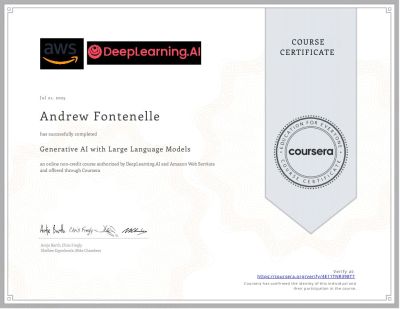
Generative AI with Large Language Models
Training
Covers foundational knowledge, practical skills, and a functional understanding of how generative AI works. The latest research on Gen AI aims to understand how companies are creating value with cutting-edge technology.
Generative AI: Prompt Engineering
Training
This IBM course covered Generative AI, Large Language Models (LLMs), Prompt Engineering, Prompt Patterns, and Tools for Prompt Engineering.

Generative AI Practitioner
Achievement
This badge signifies practical skills in working with Generative AI, including hands-on experience with large language models and prompt engineering techniques.
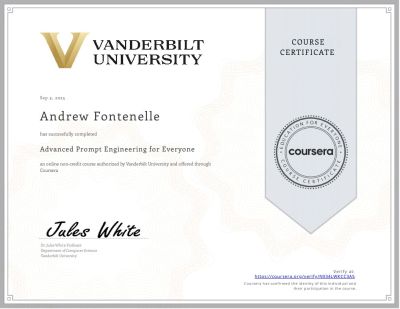
Advanced Prompt Engineering for Everyone
Training
This Vanderbilt University course covered In-Context Learning, Retrieval Augmented Generation (RAG), Template Pattern and Examples, AI Capabilities for Everyday Use.
Pega certifications
Certified Pega Business Architect (CPBA)

The Certified Pega Business Architect (CPBA) certification concentrates on the ability to participate in the design and construction of a Pega application.
Certified Pega System Architect (CPSA)
The Certified Pega System Architect (CPBA) career path is for developers and technical staff members who develop Pega applications. This certification provides a baseline measurement on your knowledge of Pega Platform.
Certified Pega Senior System Architect (CPSSA)

The Certified Pega Senior System Architect (CPSSA) certification validates your ability to use Pega to design and build for reusability across multiple lines of business.
Continuing with Pega Enablement

In 2026, I passed the Pega Certified Lead System Architect (PCLSA) Architecture Exam, the first mandatory stage of the PCLSA certification process. I have yet to take the Pega Certified Lead System Architect Application Design and Build exam, the second stage, which, once completed, will be the highest level of technical certification offered for the Pega Platform.